Live Earth
Earthquakes today, on a true-size map
Every earthquake of magnitude 2.5 and up that the US Geological Survey has recorded in the past day or week, where it struck, how strong and how deep.
Right now
What you are looking at
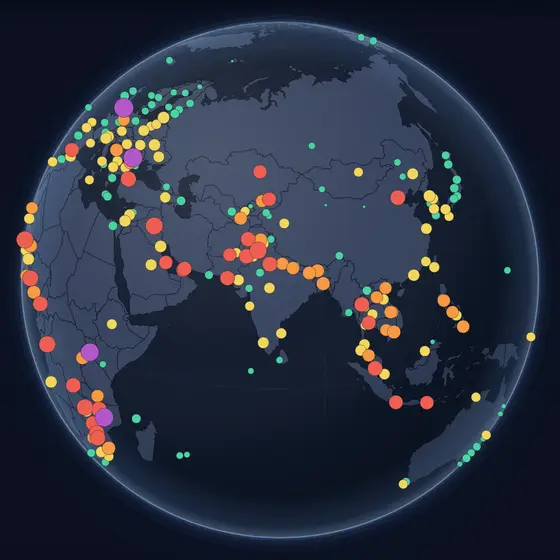
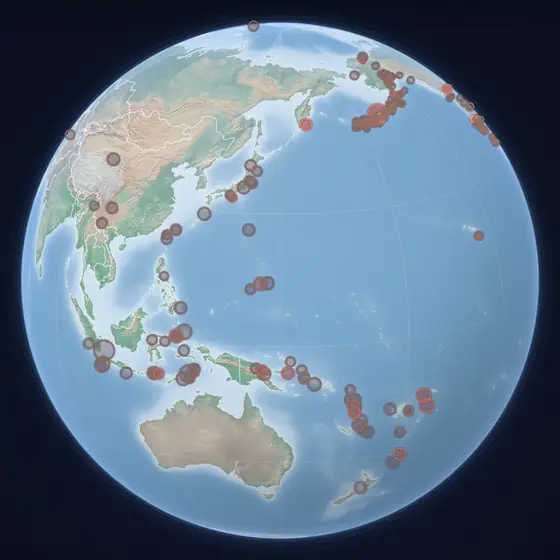
Each circle is one earthquake. Its size grows with the magnitude and its colour tells how long ago it happened, from the last hour to the past week. On a globe you can see how they gather along the edges of the tectonic plates — the Pacific Ring of Fire above all — because the map is equal-area and no region looks bigger than it is.
How to read it
- A bigger circle is a stronger quake: every step of one in magnitude releases about 32 times more energy.
- The brightest circles are the newest; switch between the past day and the past week.
- Tap a circle for the magnitude, the depth, the time and a link to the event's page at USGS.
Where the data comes from
USGS real-time earthquake feeds (public domain), magnitude 2.5 and up. Kartavera asks for them every five minutes while the layer is open.
Questions
- How many earthquakes happen every day?
- Tens of thousands of tremors shake the Earth every day, but most are too small to feel. Of magnitude 2.5 and up — the ones listed here — there are usually a few dozen worldwide in a day, more after a large quake sets off aftershocks.
- Why do earthquakes happen in the same places?
- Most occur where tectonic plates meet: they slide past, pull apart or dive beneath one another, and the stress is released in sudden slips. That is why they trace lines around the Pacific, through the Himalayas and along the mid-ocean ridges.
- How current is this map?
- USGS updates its feed every minute; Kartavera checks it every five minutes while someone has the layer open, so a new quake appears within a few minutes of being recorded.