Earth and space
The Earth and the Moon, where they are now
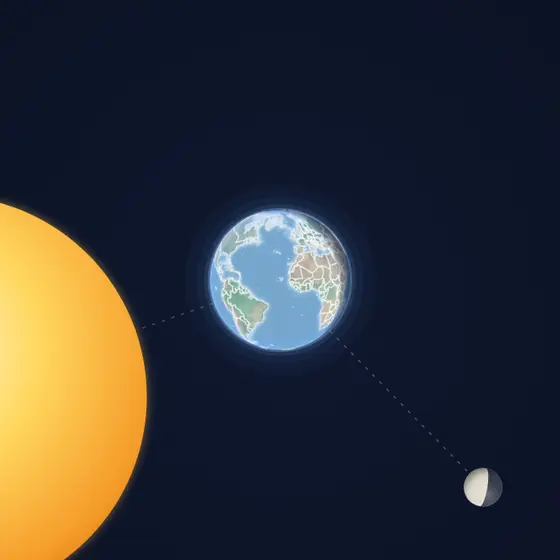
The Moon's phase, its distance from the Earth and the direction of the Sun for this moment, drawn to true scale — and the next solar and lunar eclipse.
Right now
What you are looking at
The drawing puts the Earth and the Moon at their real sizes and their real distance apart, which makes the Moon look surprisingly far and small. Its distance changes by about 50,000 km over a month, and the phase follows the angle between it and the Sun. You can run time forward to watch a month go by.
How to read it
- The lit side of the Moon faces the Sun; the phase is how much of that lit side the Earth sees.
- The distance swings between about 356,500 km at perigee and 406,700 km at apogee.
- Speed up time to see the next full moon, or the next eclipse come round.
Where the data comes from
Calculated in your browser from Meeus's lunar theory (Astronomical Algorithms), accurate to a hundredth of a degree; eclipse dates are found to within a few hours.
Questions
- What phase is the Moon in today?
- The figures at the top of this page show today's phase and how much of the Moon is lit, worked out for the minute you opened it.
- Why isn't there an eclipse every month?
- The Moon's orbit is tilted about 5° to the Earth's, so at most new and full moons it passes above or below the Sun's line. An eclipse happens only when a new or full moon falls near one of the two crossing points.
- How far away is the Moon?
- On average about 384,400 km — some thirty Earths lined up. Light takes about 1.3 seconds to cross it.