Earth and space
The Solar System, where the planets are today
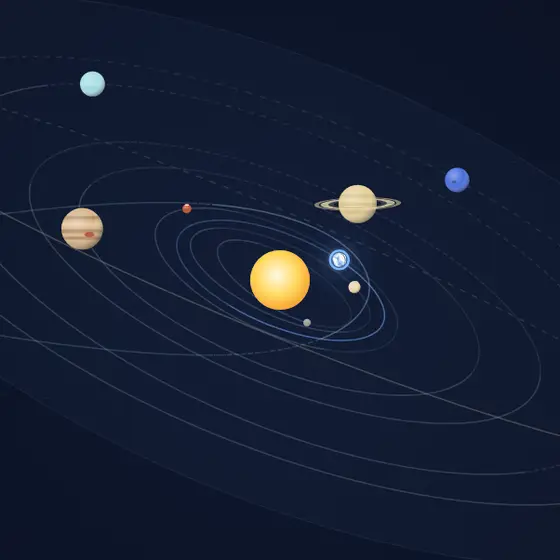
The eight planets, Pluto and Halley's Comet on their real orbits, in the places they are at this moment — with their distances from the Sun and from us.
Right now
What you are looking at
The orbits are drawn from the planets' orbital elements, so every position is where that planet really is today. The tilts of the orbits are real too, and can be exaggerated to see them. Run time forward and the inner planets race around while the outer ones barely move.
How to read it
- The table lists each body's distance from us in kilometres and from the Sun in astronomical units, and the tilt of its orbit.
- Tilt the view from straight above (2D) to the side (3D) to see how flat the Solar System is.
- Pick a planet for its size, the length of its day and its year, and what kind of world it is.
Where the data comes from
Calculated in your browser from JPL's Approximate Positions of the Planets (E. M. Standish), accurate to a fraction of a degree between 1800 and 2050.
Questions
- Which planet is closest to Earth right now?
- It changes. Venus comes nearest of all at its closest approach, but Mercury is on average the closest planet to the Earth — and to every other planet. The table on the map shows the distances for today.
- How far is Mars from Earth today?
- Between about 56 and 400 million km, depending on where both planets are on their orbits. The figures at the top of this page give today's distance.
- Is the Solar System really flat?
- Nearly. Most planets orbit within a few degrees of the Earth's orbital plane; Mercury is the most tilted at 7°, and Pluto at 17°.