Palestine vs Qatar
Qatar is 39% larger than Palestine.
PalestineQatarPalestine moved onto Qatar · Equal-area projection
0.72×
Palestine is 0.72× the area of Qatar. Put the other way, Qatar is 1.39× the size of Palestine.
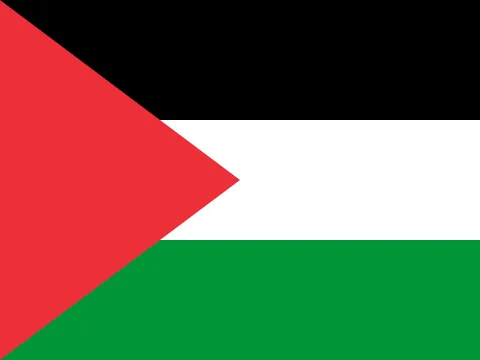 Palestine | 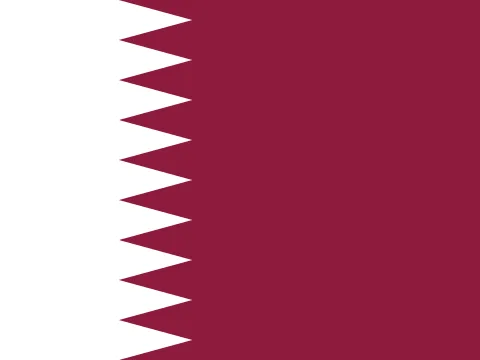 Qatar | |
|---|---|---|
| Size | ||
| AreaQatar: 1.39× the area | 8,220 km² | 11,437 km²#159 of 194 |
| Coastline | Has a coast | Has a coast |
| Land neighbours | 3 | 1 |
| People | ||
| PopulationPalestine: 1.82× the population | 5,413,5962025 | 2,972,215#136 of 194 · 2025 |
| DensityPalestine: 2.53× the density | 659 / km² | 260 / km²#36 of 194 |
| Urban populationQatar: 1.14× the urban share | 87%2025 | 99%#6 of 192 · 2025 |
| Fertility ratePalestine: 1.89× the births per woman | 3.25 per woman2024 | 1.72 per woman#115 of 192 · 2024 |
| Population growthQatar: 1.59 points higher | +2.33%2025 | +3.92%#4 of 192 · 2025 |
| Birth ratePalestine: 2.79× the birth rate | 26.5 per 1,0002024 | 9.5 per 1,000#150 of 192 · 2024 |
| Death ratePalestine: 5.36× the death rate | 5.9 per 1,0002024 | 1.1 per 1,000#191 of 192 · 2024 |
| Children under 15Palestine: 22.6 points higher | 37.6%2025 | 15.0%#162 of 192 · 2025 |
| People over 65Palestine: 2.2 points higher | 3.9%2025 | 1.7%#192 of 192 · 2025 |
| Net migrationQatar: 16.5 per 1,000 higher | −4.3 per 1,0002025 | +12.2 per 1,000#6 of 192 · 2025 |
| Refugees abroadPalestine: 447× the refugees for its size | 8.93 per 1,0002025 | 0.02 per 1,000#145 of 190 · 2025 |
| Health & education | ||
| Life expectancyQatar: 13.3 years longer | 69.2 years2024 | 82.5 years#22 of 192 · 2024 |
| Infant mortalityPalestine: 3.54× the infant mortality | 17.0 per 1,000 births2024 | 4.8 per 1,000 births#143 of 191 · 2024 |
| DoctorsQatar: 1.39× the doctors per person | 2.17 per 1,0002018 | 3.02 per 1,000#59 of 178 · 2023 |
| University enrolmentPalestine: 1.03× the university enrolment | 44.5%2023 | 43.0%#86 of 145 · 2024 |
| Human Development IndexQatar: 0.212 higher | 0.6742023 | 0.886#42 of 190 · 2023 |
| Economy | ||
| GNI per capitaQatar: 22.9× the income per person | $3,2502025 | $74,330#9 of 185 · 2025 |
| GDPQatar: 12.6× the economy | $17.17B2025 | $215.56B2025 |
| Income group | Lower-middle income | High income |
| GDP per capita (PPP)Qatar: 25.8× the output per person | $5,0002025 | $128,883#4 of 184 · 2025 |
| GDP growthPalestine: 1.4 points higher | +4.3%2025 | +2.9%#104 of 187 · 2025 |
| InflationPalestine: 8.5 points higher | +9.8%2025 | +1.3%#136 of 176 · 2024 |
| UnemploymentPalestine: 244× the unemployment | 24.4%2022 | 0.1%#178 of 178 · 2025 |
| Extreme poverty | 2.1%2023 | 0.0%#136 of 149 · 2017 |
| Income inequality (Gini)Palestine: 1.3 higher | 36.42023 | 35.1#72 of 149 · 2017 |
| Jobs in agriculturePalestine: 4.7 points higher | 6.3% of jobs2022 | 1.6% of jobs#162 of 178 · 2025 |
| Jobs in industryQatar: 8.1 points higher | 29.9% of jobs2022 | 38.0% of jobs#2 of 178 · 2025 |
| Jobs in servicesPalestine: 3.4 points higher | 63.8% of jobs2022 | 60.4% of jobs#83 of 178 · 2025 |
| Foreign investmentPalestine: 0.5 points higher | 1.9% of GDP2025 | 1.4% of GDP#112 of 184 · 2025 |
| ExportsQatar: 47.4 points higher | 21.2% of GDP2025 | 68.6% of GDP#26 of 168 · 2022 |
| Military spending | — | 6.5% of GDP#6 of 155 · 2022 |
| Internet usersQatar: 1.13× the share online | 87%2023 | 98%#11 of 184 · 2024 |
| Mobile subscriptionsQatar: 2.0× the mobile subscriptions | 77 per 1002023 | 154 per 100#25 of 191 · 2024 |
| Energy & environment | ||
| Forest areaPalestine: 18× the forest share | 2% of land2024 | 0% of land#187 of 192 · 2024 |
| CO₂ per person | — | 47.3 t a year#2 of 185 · 2024 |
| Renewable energyPalestine: 15.4 points higher | 15.4%2022 | 0.0%#188 of 190 · 2021 |
| Access to electricityThe same | 100.0%2024 | 100.0%#1 of 192 · 2024 |
| Air pollution (PM2.5)Qatar: 4.81× the air pollution | 22.4 µg/m³2023 | 107.8 µg/m³#1 of 191 · 2023 |
| Protected landQatar: 5.6 points higher | 10.0% of land2025 | 15.6% of land#111 of 191 · 2025 |
| Arable landPalestine: 5.2 points higher | 7.0% of land2024 | 1.8% of land#165 of 190 · 2024 |
| Water stressQatar: 9.02× the water stress | 47.8%2021 | 431.0%#5 of 176 · 2022 |
| PrecipitationPalestine: 5.43× the rain and snow | 402 mm2021 | 74 mm#177 of 180 · 2022 |
| Governance & safety | ||
| Political stabilityQatar: 2.95 higher | −1.912025 | +1.04#31 of 193 · 2025 |
| Control of corruptionQatar: 1.46 higher | −0.582025 | +0.88#38 of 193 · 2025 |
| Homicide ratePalestine: 6.0× the homicide rate | 0.6 per 100,0002022 | 0.1 per 100,000#144 of 146 · 2022 |
| State | ||
| Status | Status disputed | Independent state |
| Government | — | Absolute monarchy |
| Capital | East Jerusalem | Doha |
| Currency | Israeli new shekel (ILS) | Qatari riyal (QAR) |
| Official languages | Arabic | Arabic |
| Traffic drives | On the right | On the right |
| Time zone | UTC+2, summer time UTC+3 | UTC+3 |
| Calling code | +970 | +974 |
| Region | Western Asia, Asia | Western Asia, Asia |
Area: Wikidata. Population, income, health, economy, environment and governance: World Bank. Human Development Index: UNDP. Government: CIA World Factbook. Ranks among the 194 independent states. All sources
Why the map you grew up with disagrees
On a Mercator map, area grows with distance from the equator. Palestine sits at about 32° N and is stretched to 1.39× its true area; Qatar at 25° N is stretched to 1.22×. Here the two are distorted about the same amount, so Mercator gets this pair roughly right. The figure above uses the Equal Earth projection, where every square kilometre is drawn the same size.
Questions about this pair
- Is Palestine bigger than Qatar?
- No. Palestine is 28% smaller than Qatar. Palestine covers 8,220 km² and Qatar covers 11,437 km².
- How many times does Palestine fit into Qatar?
- About 1.4 times: Qatar has 1.39× the area of Palestine.
- Why do Palestine and Qatar look different on Google Maps?
- Web maps use the Mercator projection, which stretches area with distance from the equator. Palestine is drawn about 1.39× its true area there and Qatar about 1.22×. For this pair the distortion is similar, so Mercator gets the comparison roughly right. Kartavera uses Equal Earth, where every square kilometre is drawn the same size.
- Which has more people, Palestine or Qatar?
- Palestine: 5,413,596 people against 2,972,215. Density: Palestine 659 per km², Qatar 260 per km².
- Which is richer, Palestine or Qatar?
- By gross national income per person, Qatar: $74,330 against $3,250 (World Bank, Atlas method, 2025) — 22.9× as much.
- Where do people live longer, Palestine or Qatar?
- In Qatar: life expectancy at birth is 82.5 years, against 69.2 — 13.3 years longer (World Bank, 2024).