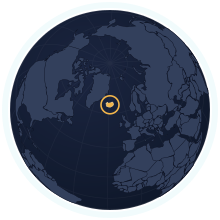
Iceland at its true size
Iceland covers 103,004 km², number 106 of 194 countries by area. Home to 392,404 people (2025). A Mercator map draws it about 5.6× too large.
Equal-area projection · Natural Earth 50m
| Area | 103,004 km² Wikidata |
|---|---|
| Population | 392,404 World Bank, 2025 |
| Density | 3.8 per km² |
| Capital | Reykjavik |
| Local time in Reykjavik | |
| Time zone | UTC IANA |
| Currency | Icelandic króna (ISK) Wikidata |
| Languages | Icelandic |
| Traffic | On the right |
| Region | Northern Europe, Europe |
| Status | Independent state |
| Member of | NATOSchengen AreaOECD |
| Coast | Has a coastline |
| Calling code | +354 |
| Codes | IS · ISL · 352 |
Weather in Reykjavik now
Now
—Loading the forecast…
The next three days
Weather data: MET Norway (CC BY 4.0), updated hourly · Temperatures on the map
Where Iceland ranks
Among the independent states, in 44 rankings. Each links to its table.
People
- Population#172 of 194392,404 people#39 of 44 in Europe
- Population density#191 of 1943.8 people per km²#44 of 44 in Europe
- Urban population#12 of 19294% urban#6 of 43 in Europe
- Fertility rate#127 of 1921.56 births per woman#7 of 43 in Europe
- Population growth#68 of 192+1.51% a year#4 of 43 in Europe
- Birth rate#119 of 19211.2 births per 1,000 people#1 of 43 in Europe
- Death rate#112 of 1926.8 deaths per 1,000 people#40 of 43 in Europe
- Children under 15#135 of 19217.5% under 15#4 of 43 in Europe
- People over 65#51 of 19216.0% aged 65 and over#42 of 43 in Europe
- Net migration#13 of 192+6.9 per 1,000 people#5 of 43 in Europe
- Refugees abroad#174 of 1900.00 refugees abroad per 1,000 people#32 of 41 in Europe
Health & education
- Life expectancy#21 of 19282.8 years#14 of 43 in Europe
- Infant mortality#180 of 1912.1 infant deaths per 1,000 live births#32 of 42 in Europe
- Doctors#21 of 1784.37 doctors per 1,000 people#16 of 41 in Europe
- University enrolment#35 of 14576.5% gross enrolment#22 of 43 in Europe
- Human Development Index#1 of 190an index of 0.972#1 of 42 in Europe
Economy
- GNI per capita#4 of 185$89,220 a person#4 of 41 in Europe
- Internet users#10 of 18498% online#6 of 43 in Europe
- GDP per capita (PPP)#11 of 184$83,431 a person#6 of 41 in Europe
- GDP growth#148 of 187+1.3% a year#25 of 42 in Europe
- Inflation#52 of 176+4.1% a year#9 of 40 in Europe
- Unemployment#119 of 1783.6% of the labour force#31 of 39 in Europe
- Extreme poverty#126 of 1490.1% under $3.00 a day#27 of 39 in Europe
- Income inequality (Gini)#136 of 149a Gini index of 26.8#30 of 39 in Europe
- Jobs in agriculture#141 of 1783.6% of jobs#20 of 39 in Europe
- Jobs in industry#102 of 17818.2% of jobs#29 of 39 in Europe
- Jobs in services#22 of 17878.1% of jobs#11 of 39 in Europe
- Foreign investment#176 of 184-2.2% of GDP#37 of 41 in Europe
- Exports#71 of 16840.1% of GDP#29 of 40 in Europe
- Military spending#153 of 1550.0% of GDP#39 of 39 in Europe
- Mobile subscriptions#78 of 191121 subscriptions per 100 people#28 of 43 in Europe
Energy & environment
- CO₂ per person#22 of 1858.52 tonnes a person#3 of 37 in Europe
- Forest area#184 of 1921% forest#42 of 43 in Europe
- Renewable energy#13 of 19082.4% renewable#1 of 41 in Europe
- Access to electricity#1 of 192100.0% with electricity#1 of 43 in Europe
- Air pollution (PM2.5)#183 of 1914.9 µg/m³#41 of 42 in Europe
- Protected land#80 of 19120.9% of the land protected#26 of 42 in Europe
- Arable land#170 of 1901.2% of the land arable#40 of 42 in Europe
- Water stress#167 of 1760.4% of its available fresh water#38 of 38 in Europe
- Precipitation#36 of 1801,940 mm a year#1 of 37 in Europe
Governance & safety
Countries of a similar size
Every country within 25% of Iceland’s area, lit up on the map →
- South Korea1.03×Iceland and South Korea are almost exactly the same size.
- Guatemala0.95×Iceland is 5% smaller than Guatemala.
- Cuba0.94×Iceland is 6% smaller than Cuba.
- Bulgaria0.93×Iceland is 7% smaller than Bulgaria.
- Liberia0.92×Iceland is 8% smaller than Liberia.
- Honduras0.92×Iceland is 8% smaller than Honduras.
How many times does Iceland fit into…
- Russia: about 166 times
- Canada: about 97 times
- United States: about 95 times
The land itself
Rivers, summits and lakes Iceland shares with the rest of the world. Turn on “Rivers & lakes” and “Physical names” in the atlas to see them on the map.
Summits
- Hvannadalshnúkur2,110 m
Rivers are listed by the published length of their whole course, not the part inside Iceland. Figures from Wikidata, features from Natural Earth.
Questions about Iceland
- How big is Iceland?
- Iceland covers 103,004 km², which makes it number 106 of 194 countries by area. About 392,404 people live there (2025), 3.8 per km².
- Is Iceland bigger than South Korea?
- Iceland and South Korea are almost exactly the same size. Iceland: 103,004 km²; South Korea: 100,295 km².
- How much does the Mercator map distort Iceland?
- At about 65° latitude, Mercator stretches Iceland to roughly 5.6× its true area relative to a country on the equator. Kartavera draws it in the Equal Earth projection, where areas are exact.
- Does Iceland have land borders?
- No. Iceland has no land neighbours; every border is a coastline.