Canada vs Saint Vincent and the Grenadines
Canada is 25,668 times larger than Saint Vincent and the Grenadines. Saint Vincent and the Grenadines would fit into Canada about 25668 times.
CanadaSaint Vincent and the GrenadinesCanada moved onto Saint Vincent and the Grenadines · Equal-area projection
25,668×
Canada is 25,668× the area of Saint Vincent and the Grenadines.
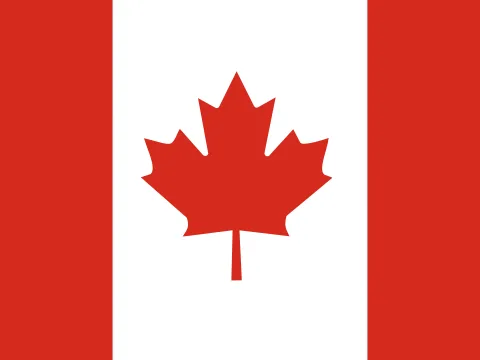 Canada Canada | 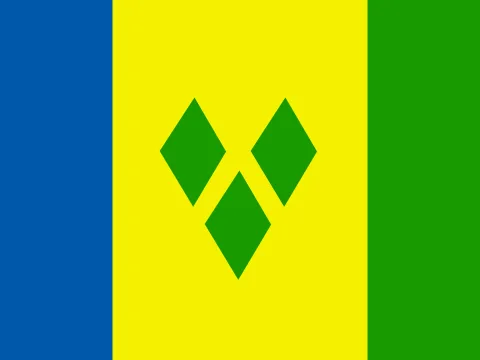 Saint Vincent and the Grenadines Saint Vincent and the Grenadines | |
|---|---|---|
| Size | ||
| AreaCanada: 25,668× the area | 9,984,670 km²#2 of 194 | 389 km²#184 of 194 |
| Coastline | Has a coast | Coast, no land border |
| Land neighbours | 1 | 0 |
| People | ||
| PopulationCanada: 417× the population | 41,651,653#38 of 194 · 2025 | 99,924#183 of 194 · 2025 |
| DensitySaint Vincent and the Grenadines: 61.6× the density | 4.2 / km²#188 of 194 | 257 / km²#39 of 194 |
| Urban populationCanada: 1.73× the urban share | 83%#36 of 192 · 2025 | 48%#132 of 192 · 2025 |
| Fertility rateSaint Vincent and the Grenadines: 1.41× the births per woman | 1.25 per woman#171 of 192 · 2024 | 1.76 per woman#112 of 192 · 2024 |
| Population growthCanada: 1.63 points higher | +0.94%#100 of 192 · 2025 | −0.69%#185 of 192 · 2025 |
| Birth rateSaint Vincent and the Grenadines: 1.35× the birth rate | 8.9 per 1,000#157 of 192 · 2024 | 12.0 per 1,000#112 of 192 · 2024 |
| Death rateSaint Vincent and the Grenadines: 1.46× the death rate | 7.9 per 1,000#72 of 192 · 2024 | 11.5 per 1,000#21 of 192 · 2024 |
| Children under 15Saint Vincent and the Grenadines: 5.9 points higher | 15.0%#162 of 192 · 2025 | 20.9%#111 of 192 · 2025 |
| People over 65Canada: 8.0 points higher | 20.3%#30 of 192 · 2025 | 12.3%#69 of 192 · 2025 |
| Net migrationCanada: 14.9 per 1,000 higher | +7.8 per 1,000#11 of 192 · 2025 | −7.1 per 1,000#177 of 192 · 2025 |
| Refugees abroadSaint Vincent and the Grenadines: 194× the refugees for its size | 0.01 per 1,000#155 of 190 · 2025 | 1.94 per 1,000#44 of 190 · 2025 |
| Health & education | ||
| Life expectancyCanada: 10.7 years longer | 82.1 years#28 of 192 · 2024 | 71.4 years#121 of 192 · 2024 |
| Infant mortalitySaint Vincent and the Grenadines: 2.17× the infant mortality | 4.7 per 1,000 births#144 of 191 · 2024 | 10.2 per 1,000 births#111 of 191 · 2024 |
| Doctors | 2.82 per 1,000#65 of 178 · 2023 | — |
| University enrolmentCanada: 1.84× the university enrolment | 76.3%#36 of 145 · 2023 | 41.5%#89 of 145 · 2022 |
| Human Development IndexCanada: 0.141 higher | 0.939#15 of 190 · 2023 | 0.798#75 of 190 · 2023 |
| Economy | ||
| GNI per capitaCanada: 4.7× the income per person | $56,420#16 of 185 · 2025 | $12,000#75 of 185 · 2025 |
| GDPCanada: 1,849× the economy | $2.32T2025 | $1.26B2025 |
| Income group | High income | Upper-middle income |
| GDP per capita (PPP)Canada: 2.93× the output per person | $66,746#24 of 184 · 2025 | $22,799#83 of 184 · 2025 |
| GDP growthSaint Vincent and the Grenadines: 1.7 points higher | +1.7%#141 of 187 · 2025 | +3.4%#89 of 187 · 2025 |
| InflationCanada: 1.3 points higher | +2.1%#116 of 176 · 2025 | +0.8%#147 of 176 · 2025 |
| UnemploymentSaint Vincent and the Grenadines: 2.61× the unemployment | 6.9%#58 of 178 · 2025 | 18.0%#10 of 178 · 2025 |
| Extreme poverty | 0.3%#116 of 149 · 2022 | — |
| Income inequality (Gini) | 31.5#107 of 149 · 2022 | — |
| Jobs in agricultureSaint Vincent and the Grenadines: 8.0 points higher | 1.1% of jobs#169 of 178 · 2025 | 9.1% of jobs#114 of 178 · 2025 |
| Jobs in industrySaint Vincent and the Grenadines: 2.4 points higher | 18.7% of jobs#96 of 178 · 2025 | 21.1% of jobs#70 of 178 · 2025 |
| Jobs in servicesCanada: 10.3 points higher | 80.1% of jobs#13 of 178 · 2025 | 69.8% of jobs#53 of 178 · 2025 |
| Foreign investmentSaint Vincent and the Grenadines: 5.9 points higher | 3.0% of GDP#65 of 184 · 2025 | 8.9% of GDP#21 of 184 · 2025 |
| Exports | 31.3% of GDP#100 of 168 · 2025 | — |
| Military spending | 1.6% of GDP#80 of 155 · 2025 | — |
| Internet usersCanada: 1.24× the share online | 94%#28 of 184 · 2024 | 76%#108 of 184 · 2024 |
| Mobile subscriptionsSaint Vincent and the Grenadines: 1.15× the mobile subscriptions | 94 per 100#137 of 191 · 2024 | 108 per 100#114 of 191 · 2024 |
| Energy & environment | ||
| Forest areaSaint Vincent and the Grenadines: 1.75× the forest share | 42% of land#62 of 192 · 2024 | 73% of land#12 of 192 · 2024 |
| CO₂ per personCanada: 10.7× the CO₂ per person | 14.0 t a year#11 of 185 · 2024 | 1.31 t a year#119 of 185 · 2024 |
| Renewable energyCanada: 18.7 points higher | 23.8%#96 of 190 · 2021 | 5.1%#158 of 190 · 2022 |
| Access to electricityThe same | 100.0%#1 of 192 · 2024 | 100.0%#1 of 192 · 2024 |
| Air pollution (PM2.5)Saint Vincent and the Grenadines: 1.61× the air pollution | 6.6 µg/m³#176 of 191 · 2023 | 10.6 µg/m³#151 of 191 · 2023 |
| Protected landSaint Vincent and the Grenadines: 9.7 points higher | 12.9% of land#131 of 191 · 2025 | 22.6% of land#64 of 191 · 2025 |
| Arable landSaint Vincent and the Grenadines: 0.8 points higher | 4.3% of land#134 of 190 · 2024 | 5.1% of land#130 of 190 · 2024 |
| Water stressSaint Vincent and the Grenadines: 2.14× the water stress | 3.7%#132 of 176 · 2022 | 7.9%#101 of 176 · 2022 |
| PrecipitationSaint Vincent and the Grenadines: 2.95× the rain and snow | 537 mm#138 of 180 · 2022 | 1,583 mm#52 of 180 · 2022 |
| Governance & safety | ||
| Political stabilitySaint Vincent and the Grenadines: 0.41 higher | +0.81#48 of 193 · 2025 | +1.22#19 of 193 · 2025 |
| Control of corruptionCanada: 0.87 higher | +1.59#15 of 193 · 2025 | +0.72#45 of 193 · 2025 |
| Homicide rateSaint Vincent and the Grenadines: 25.6× the homicide rate | 2.0 per 100,000#80 of 146 · 2023 | 51.3 per 100,000#2 of 146 · 2023 |
| State | ||
| Status | Independent state | Independent state |
| Government | Constitutional monarchyfederal parliamentary democracy (Parliament of Canada) under a constitutional monarchy; a Commonwealth realm; federal and state authorities and responsibilities regulated in constitution | Constitutional monarchyparliamentary democracy under a constitutional monarchy; a Commonwealth realm |
| Member of | NATO, OECD, G7, G20 | — |
| Capital | Ottawa | Kingstown |
| Currency | Canadian dollar (CAD) | Eastern Caribbean dollar (XCD) |
| Official languages | English, French | English |
| Traffic drives | On the right | On the left |
| Time zone | UTC−5, summer time UTC−4 · UTC−8 to UTC−3:30, 6 time zones | UTC−4 |
| Calling code | +1 | +1 784 |
| Region | Northern America, North America | Caribbean, North America |
Area: Wikidata. Population, income, health, economy, environment and governance: World Bank. Human Development Index: UNDP. Government: CIA World Factbook. Ranks among the 194 independent states. All sources
Why the map you grew up with disagrees
On a Mercator map, area grows with distance from the equator. Canada sits at about 60° N and is stretched to 4.1× its true area; Saint Vincent and the Grenadines at 13° N is stretched to 1.06×. That difference is why Canada looks so much bigger than it is next to Saint Vincent and the Grenadines. The figure above uses the Equal Earth projection, where every square kilometre is drawn the same size.
Questions about this pair
- Is Canada bigger than Saint Vincent and the Grenadines?
- Yes. Canada is 25,668 times larger than Saint Vincent and the Grenadines. Canada covers 9,984,670 km² and Saint Vincent and the Grenadines covers 389 km².
- How many times does Saint Vincent and the Grenadines fit into Canada?
- About 25668 times: Canada has 25,668× the area of Saint Vincent and the Grenadines.
- Why do Canada and Saint Vincent and the Grenadines look different on Google Maps?
- Web maps use the Mercator projection, which stretches area with distance from the equator. Canada is drawn about 4.1× its true area there and Saint Vincent and the Grenadines about 1.06×. That is why Canada looks so much bigger than it really is next to Saint Vincent and the Grenadines. Kartavera uses Equal Earth, where every square kilometre is drawn the same size.
- Which has more people, Canada or Saint Vincent and the Grenadines?
- Canada: 41,651,653 people against 99,924. Density: Canada 4.2 per km², Saint Vincent and the Grenadines 257 per km².
- Which is richer, Canada or Saint Vincent and the Grenadines?
- By gross national income per person, Canada: $56,420 against $12,000 (World Bank, Atlas method, 2025) — 4.7× as much.
- Where do people live longer, Canada or Saint Vincent and the Grenadines?
- In Canada: life expectancy at birth is 82.1 years, against 71.4 — 10.7 years longer (World Bank, 2024).
- What kind of government do Canada and Saint Vincent and the Grenadines have?
- The same form of government, by constitution: constitutional monarchy (CIA World Factbook).